___________________________________________________________________________
Name:Ashfarin Nasiha
Course: ENGL 210
Instructor: Brandon Borcoman
Date: 06/30/26
Title: Self-Assessment essay
Writing for Engineering was a tough class, I must say, but the way our professor organized the course made me enjoy the process of learning and writing. In the beginning of the class, we had free-writing sessions where we could write anything and express our own opinions. From there, we gradually moved into analyzing different genres and rhetorical situations, which made me realize that writing in engineering is not simply about presenting information but also about understanding purpose, audience, and context. Throughout the semester, I learned how to read critically, evaluate sources, and communicate technical information in a clear and professional manner.
For the memo research citations in our group, we went through the FEMA (2021) case study, which represents a technical, non-scholarly policy report genre designed to inform utility companies, policymakers, and emergency management professionals about infrastructure resilience. As compared to an academic journal article, its goal is not to generate theory but to provide a practical case study that can help make decisions. Next, for another technical description in class exercise, we have the Hyperloop Alpha by Elon Musk. The Hyperloop Alpha is a technical proposal document genre with a future concept of transportation. Its primary audience consists of engineers, policy makers, and technocrats who might assess or further implement the proposal. The goal of the document is to inform and convince the readers about the viability and efficiency of the Hyperloop system as compared to other existing means of transport. These were just some examples from our research and class readings that provided insight into the way the writers modify their communication based on rhetorical situations.
During our memo group work, it took me the longest to decide which research sources to include and how to adjust them to fit our purpose. However, through collaboration, I learned several strategies from my classmates. One strategy was carefully reading sources, taking notes, and explaining the information to myself so that I fully understood what I was writing. This process improved the cohesiveness of my writing because I became more intentional about connecting my ideas and supporting my arguments. Another strategy I practiced was reviewing my drafts and using AI tools to modify grammar and sentence structure being truthful to my original ideas. Reading this reviewed writing and adjusting my writing style again not only improved my writing but also helped me learn new vocabulary and ways of expressing different ideas. Finally, I revised and edited my drafts multiple times while collaborating on different sections of the assignments, which taught me that effective writing is an ongoing process of drafting, revising, and refining.
Looking back at my proposal for the Modular Hydronic Wall Panel System, I can clearly identify where I put key rhetorical strategies into practice. Instead of simply claiming that my design was affordable, I used competitive differentiation by directly contrasting it with Messana Hydronic Technologies. I explained that while high-end systems are often unaffordable and require costly building upgrades, my design is an additional system that can be installed without demolition. This comparison allowed me to establish a unique value proposition for low-income tenants and communicate why my design addresses an existing gap in the market. At the same time, I moved away from purely descriptive writing and adopted a more objective, impact-oriented engineering tone. In my technical description, I introduced the project as an “advanced, noninvasive surface retrofit engineered to function as a decoupled sensible heat exchanger.” By intentionally using terms such as “noninvasive” and describing the system’s three-loop architecture, I was able to present my design with precision while emphasizing both efficiency and minimized structural risk.
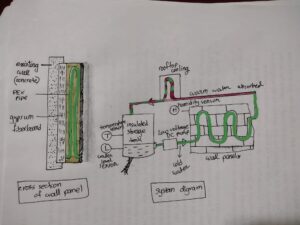
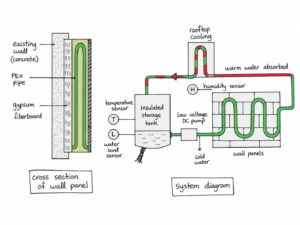
In a way, I may say I used digital technologies indirectly in the course. For my engineering proposal, I initially created a hand-drawn diagram and then used an AI tool to regenerate it into a digital version. I chose to include the digital diagram because it was clearer, more precise, and visually appealing than my original drawing. More importantly, it made the information easier to understand and more presentable to a variety of audiences.
Similarly, while working on my lab report, I used peer-reviewed journal articles such as Jacques et al. (2019), Hsu et al. (2021), and Raza et al. (2024), which I found through academic databases and reliable online archives. This was achieved based on the ability to authenticate these sources by the simple fact that these were peer-reviewed journals where information was provided by experts in the field. Timeliness was also taken into consideration through the choice of articles that have been published recently, specifically the two articles that will be published in 2021 and 2024. For the engineering proposal, I have used an article from The New York Times (Hu, 2026) which is a current newspaper article to give me current information regarding heat dangers in New York City and have used the information provided by Messana to learn about the cost and disadvantages of the existing hydronic radiant system.
Moreover, I discovered how to effectively process the technical sources that do not have a conventional structure, including reports issued by the agencies of government or journals published by the industry of engineering. Specifically, while citing standards on safety of self-driving vehicles, I identified both the corporate author and the agency to which it belongs, citing the National Highway Traffic Safety Administration (NHTSA, 2022). Knowing how to deal with a wide variety of sources helped me to comprehend the scope of research wider than just scholarly journals. Overall, this course has strengthened my ability to write cohesively and think rhetorically and communicate technical ideas in a professional manner and precise audience in consideration.

