_________________________________________________________________________
Name:Ashfarin Nasiha
Course: ENGL 210
Instructor: Brandon Borcoman
Title: Modular Hydronic Panel System
Date:07/01/26
Introduction:
In New York City, heat abnormalities have become a growing concern to public health. Standard solutions such as using mechanical compressive air-conditioners lead to very high costs, need considerable amounts of electricity from the grid, and require huge structural modifications. The proposal, Modular Hydronic Panel System presents an alternative engineering framework than these. Being a surface mounted and noninvasive approach, the system can be installed on the interior surfaces of walls as an additional module without demolishing any part of the wall structure or requiring any change in its architecture. This system delivers an affordable structural cooling option with an initial production cost under $1,000, serving as a scalable alternative for New York City’s residential upgrades.
The Urgent Need for Innovation:
The environmental conditions in the New York City metropolitan area have been significantly changed by global climate change. The rate of continuously high temperatures, also known as “urban heat waves,” has increased in both intensity and duration. This is starkly evident in the historic late June and early July 2026 heat emergency, where a massive regional heat dome drove actual temperatures toward triple digits for the first time in over a decade, triggering official Excessive Heat Warnings citywide. The Urban Heat Island (UHI) effect, which results in midnight atmospheric baselines that are up to 7°F (3.9°C) warmer than nearby rural buffers due to the massive amounts of solar radiation captured and stored by structural surfaces, asphalt, and high-density materials, essentially worsens this structural reality.Increased medical conditions associated with heat and clinical death events are the main result of this structural heat storage, and they are primarily concentrated among communities with low incomes, the elderly, and residents of public housing complexes.This continuous immense heat trapping is particularly dangerous when its more than one day events, as regional meteorologists have noted that overnight temperatures struggling to drop below 80°F prevent building envelopes from cooling down, locking intense thermal energy indoors. The city experiences an average of 500 heat-related premature deaths every year, according to empirical data from the NYC Department of Health and Mental Hygiene (DOHMH) Heat-Related Mortality Index. Public health evaluations directly link these deaths to structural injustices, pointing out that deaths associated with heat mostly take place in homes without air conditioning and disproportionately affect .
Furthermore,heavy materials like brick and concrete, which retain a lot of heat during the day and gradually release it at night, are frequently used in older apartment buildings in New York City. This produces a constant “heat load” that is too much for simple window air conditioners to manage. A suitable solution should be small so it doesn’t take up space, adhere directly to the existing walls, and prevent heat from entering the living area.
Target audience :
The system is primarily intended for low-income families, working-class NYC residents, and tenants of public housing who do not currently have dependable cooling systems and who live in older, poorly insulated multi-family buildings. Due to the unpredictable nature of electricity prices, many members of these groups still cannot afford the traditional method of installing mechanical vapor compressive air conditioning equipment. Furthermore, without altering the windows or frame structure, the current building envelopes are not physically able to handle such compression systems.
Downside of pre-existing companies of the same innovation:
Current commercially available systems of radiant cooling, such as those developed by high end companies such as Messana Hydronic Technologies, provide excellent thermal comfort but their entry fees are unaffordable. Basic equipment for commercial installations usually costs between $10 and $20 per square foot; supplementary equipment might cost thousands of dollars per zone. Furthermore, these solutions are designed to be put in luxurious residential buildings from the foundation up or in the event of a thorough interior renovation. They requires removal of drywall, channeling through the structure, and custom plastering of walls with installation of new tubes in it. This expensive construction process makes it basically not for lower-class inhabitants and governmental renovations of residential homes. Severe energy spikes during intense heat waves are caused by the inability of the current urban cooling infrastructure to keep up with growing city temperatures. This technology provides an adaptable method to lower urban energy demand without requiring disruptive infrastructure overhauls by introducing a non-destructive, efficient radiant system. But the suggested hydronic wall panel is an additional system that can be placed without demolition, making it less expensive and simpler to implement than costly building upgrades. Building owners or city workers might utilize it extensively to cut electricity demand during peak summer use, increase indoor comfort, and lower health hazards associated with heat.
Technical Description of the Innovation:
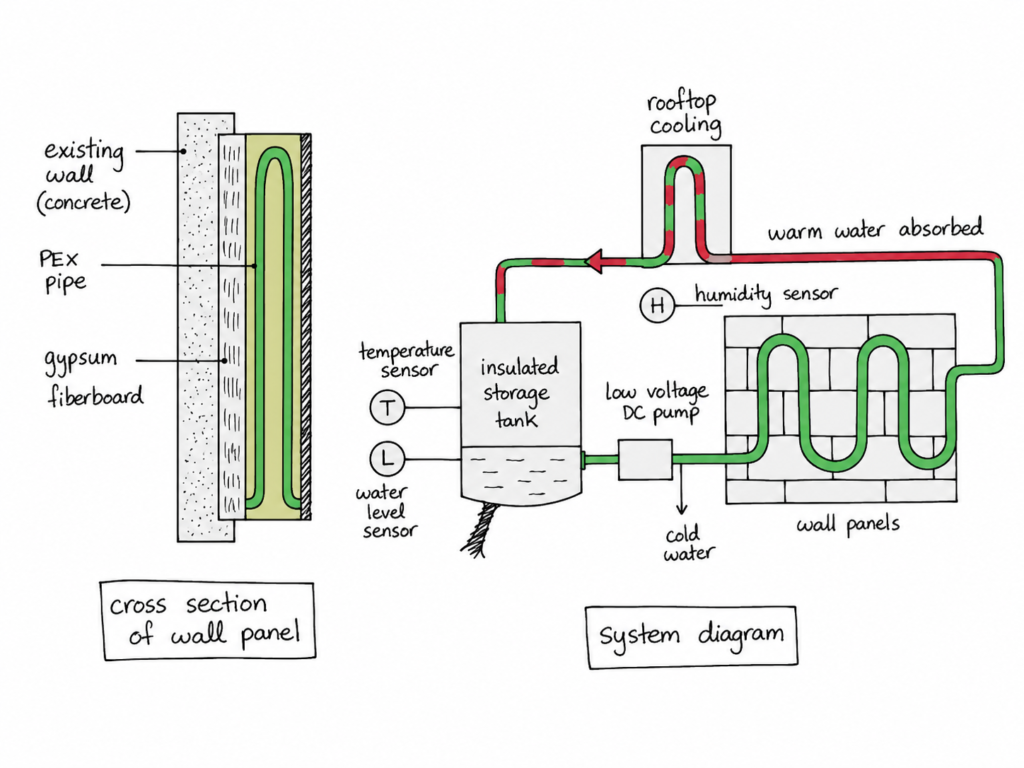
The Modular Hydronic Wall Panel System is an advanced, noninvasive surface retrofit engineered to function as a decoupled sensible heat exchanger. The full system architecture is made up of three loops altogether which are the internal modular heat absorption system, the thermal buffer insulation system, and the atmospheric radiative heat rejection system.
Main Components and Functions
| Component | Material | Function |
| wall cooling panels | gypsum fiberboard with pir insulation | covers existing walls and transfers cooling into the room |
| insulation layer | 25 mm polyisocyanurate foam | blocks the heating that comes in through the wall |
| pipe network | ½ inch pex tubing | carries cool water through the panels |
| connectors and valves | standard brass fittings | connects pipe joints and is easy to fix |
| storage tank | 200 litre insulated water tank | stores the cooled water and stabilizes the temperature |
| circulation pump | 12–24 v dc brushless pump with pulse width modulation(PWM) | moves water through the system |
| rooftop cooling collector | passive radiative cooling coating | releases heat from the water into the atmosphere |
| sensors | temperature and humidity sensors | monitors the indoor environment |
| controller | arduino/ esp32 | controls the pump and prevents condensation |
Process of the system:
Step 1: Cool Water Storage
Water is stored inside an insulated tank.
Step 2: Water Circulation
A low voltage pump pushes chilled water mixed with propylene glycol so it doesnot freeze in winter, through the PEX pipes inside the wall panels.
Step 3: Heat Absorption
The wall panels absorb heat from the room. The water becomes warmer as it removes heat from the indoor space.
Step 4: Rooftop Cooling
The warm water moves to the rooftop cooling collector. The special coating releases the heat into the atmosphere and cools the water again.
Step 5: Continuous Cycle
The cooled water returns to the storage tank and circulates through the system again to cool down the water further.
Inputs
- tap water treated with a safe biocide
- electrical power of only 15 30 w
- indoor heat from sunlight and warm room air
Outputs
- indoor temperature reduction of approximately 4°c to 7°c
- reduced air conditioner usage
- lower electricity costs
- near zero operating costs when powered by solar energy
User Controls
- simple wall display
- on/off button
- comfort level adjustment
- water level and system status indicators
Maintenance:
- check pipe connections occasionally
- refill water if needed
- clean rooftop cooling surface periodically
- flush pipes once a year
- replace sensors or pumps using standard hardware-store parts
The Modular Hydronic Wall Panel System is an addon wall cooling technology that uses cool water, insulated wall panels, and a rooftop heat rejection system to lower indoor temperatures. It requires very little electricity and can run on solar power and is easy to install and maintain because it uses common plumbing materials and modular components.
Cost Evaluation of the system and affordability:
The cost of this system was carried out through comparing this system to the Messana system as a base. The system consists of prefabricated panels fitted with PEX tubing at the manufacturing plant and is designed to be compatible with heat pumps and zoning.
The costing process is done through comparing the system to a prototype house that has an area of 3,000 square feet and 8 zones. The cost of materials, piping, labor, and installation will be compared.
Material & Labor Cost Comparison
| System Component | Messana Benchmark($/sq. ft.) PDF | Messana Cost(3,000 sq. ft.) PDF | Your Product Cost($/sq. ft.) | Your Product Cost(3,000 sq. ft.) |
| Radiant Panels (Tubing embedded) | $9.50 | $28,500 | $11.00 | $33,000 |
| PEX Piping & Manifolds | $1.00 | $3,000 | $0.50 (Manifolds only) | $1,500 |
| Supplemental Cooling (Fan coils) | $2.00 | $6,000 | $2.00 | $6,000 |
| Mechanical Room Equipment | $1.50 | $4,500 | $1.00 | $3,000 |
| Air-to-Water Heat Pump | $3.30 | $10,000 | $3.33 | $10,000 |
| System Controls & Automation | $2.80 | $8,500 | $1.67 | $5,000 |
| TOTAL MATERIAL COST | ~$20.10 | ~$60,300 | $19.50 | $58,500 |
| Estimated Installation Labor | ~$20.00 | ~$60,000 | $11.00 (45% faster) | $33,000 |
| TOTAL PROJECT INVESTMENT | ~$40.10 | ~$120,300 | $30.50 | $91,500 |
The system has a slightly higher material cost ($11/sq. ft. vs $9.50), but pre-installed tubing reduces piping work by 50%. Its modular, pre-plumbed design cuts installation labor by about 45%, lowering labor costs to ~$11/sq. ft. Overall, it delivers major total cost savings despite similar material pricing.
Abstract :
The following is an engineering proposal for an innovative modular hydronic panel system intended to offer a cost effective and energy saving option for providing cooling for low-income individuals including working class individuals, individuals with fixed income, and public housing inhabitants in New York City. Most of the existing buildings are not equipped with an integrated thermal management system. Furthermore, most radiant heating systems, such as those produced by Messana, require expensive demolition and installation procedures. The main problem is resolved using the add-on modules with the built in hydronic fluid piping which can be easily installed without major modifications of the building structure and minimum inconvenience for the building occupants.
Risk management :
Although environmental conditions like freezing water and pipe leaks can be potentially risky for operation, the project design reduces the probability of their occurrence through prevention through engineering. Also, critical risks have been entirely offset by having a team to respond rapidly to any disruptions on a 24/7 basis.
Conclusion
The Modular Hydronic Wall Panel System is an effective, scientifically supported development in urban environmental design. This add-on innovation solves the structural and economical constraints that have historically prevented radiant cooling retrofits in heritage multi-family homes by keeping production costs under $1,000 per zone and doing away with the requirement for intrusive wall demolition. During hazardous heat emergencies, the device provides an accessible way to lower indoor temperatures by 4°C to 7°C with a low power consumption that is easy to connect with modest solar panels. Broad deployment offers New York City a workable way to safeguard public health and provide fair, long-term climate resilience throughout all of its residential districts.
References:
Hu, W. (2026, June 30). As a heat wave grips New York City, vulnerable residents face mounting risks. The New York Times. https://www.nytimes.com/2026/06/30/nyregion/nyc-heat-wave.html
Messana. (n.d.). What are the material costs of a heating and cooling hydronic radiant system? https://messana.tech/knowledge-base/what-are-the-material-costs-of-a-heating-and-cooling-hydronic-radiant-system/

